Enciclopedia de consolas
Sega · 1985
Master System
Emulador Sega Master System
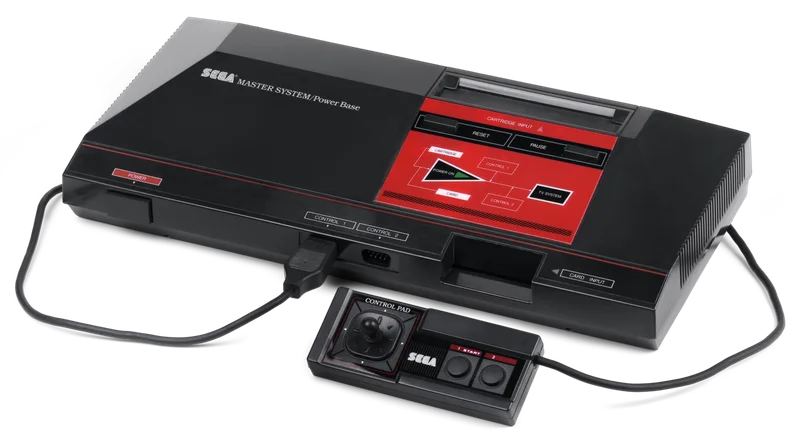
Sega’s 8-bit home platform grew from the Japanese Mark III into the internationally branded Master System.[1]
- Primer lanzamiento
- 1985
- Fabricante
- Sega
- Categoría
- Consola doméstica
- Generación
- 3
- Soportes
- ROM cartridges; Sega Cards on original model
La narración histórica se muestra en su edición canónica en inglés.
Historia de la consola
The 1985 date in the catalog marks the Mark III lineage. The overseas Master System appeared in 1986; Japan received its Master System in October 1987.[1]
The Japanese model added FM sound and built-in support for Sega’s 3-D glasses. These features should not be assumed for every overseas unit. Later Master System II hardware simplified the original design.[1]
Hitos históricos
Perfil técnico
- Procesador
- Zilog Z80[2]
- Memoria
- 8 KB work RAM + 16 KB video RAM[2]
- Pantalla y gráficos
- VDP · tile and sprite graphics[2]
- Soportes
- ROM cartridges; Sega Cards on original model[2]
- Audio
- PSG; FM on Japanese Master System[2]
- Alimentación
- External AC adapter[1]
- Controles y conectividad
- Two controller ports; console-mounted Pause button[2]
Importancia histórica
Juegos emblemáticos
Los años indican el primer lanzamiento de la versión citada. GameCapsule no distribuye estos juegos.
Variantes de hardware
Accesorios y ecosistema
Familia de sistemas
Sistemas relacionados de la colección. Estos enlaces no implican compatibilidad técnica.
Galería de hardware
Master System
Evan-Amos, public domain, via Wikimedia Commons. Public domain (PD-self)

Imagen de consola de la colección Game Capsule. No se muestra ninguna captura de juego.
Compatibilidad con GameCapsule
Este sistema figura en el catálogo. Su emulador, la importación de archivos y el juego no están disponibles hoy. No hay fecha de lanzamiento anunciada.
Expande más allá de Game Boy mientras preservas una colección coherente. Otras consolas siguen siendo solo de catálogo.
Importa tus propios archivos de juego compatibles. Game Capsule no incluye juegos comerciales.
Explora la hoja de rutaFuentes y lecturas
- Historical overview and model chronology ↗
Historical narrative, regional release precision, model chronology, commercial context and accessories
Reviewed 2026-09-30 - Sega hardware encyclopedia · original specifications ↗
Processor, memory, graphics, audio and hardware interfaces
Reviewed 2026-09-30 - Alex Kidd in Miracle World · release history ↗
Named game/version release year; descriptive context
Reviewed 2026-09-30 - Phantasy Star · release history ↗
Named game/version release year; descriptive context
Reviewed 2026-09-30 - Wonder Boy III: The Dragon’s Trap · release history ↗
Named game/version release year; descriptive context
Reviewed 2026-09-30